
Unless your Wi-Fi stopped working, you’ve probably seen the photos.
For years, Dwayne “The Rock” Johnson has been famous for his massive action-hero build. Recently, however, the actor appears noticeably slimmer, leading many fans online to say he now looks more like “The Pebble.”
Johnson addressed the speculation during an appearance at a film festival, explaining that his leaner look is related to preparation for an upcoming movie role.
At first glance, that explanation seems reasonable. After all, he’s an actor, and physical transformations are often part of the job.
But some fitness experts believe there may be more to the story. From a bodybuilding perspective, dramatic body changes at that level often involve many factors—strict training programs, precise nutrition strategies, and carefully managed conditioning phases.
While the movie role may indeed be a major reason for the transformation, it also highlights a broader reality of the entertainment industry: maintaining or changing a physique for the camera can require intense dedication and highly specialized fitness approaches.
For fans and fitness enthusiasts alike, The Rock’s latest transformation is another reminder that the bodies we see in Hollywood often reflect months of disciplined work behind the scenes.
The Rock And His “Natty” Status
In
a 2009 interview, The Rock admitted to trying anabolic steroids when he
was 18 or 19. But ever since then, he has maintained that his physique
is “all natural.”
Nothing more than hard work and clean eating. Right.
As
someone who’s made a living in the fitness industry, I’ll say this
plainly. I’m 99.99% certain that The Rock has been a long-time user of
performance-enhancing drugs (PEDs).
Not
just a few experimental cycles when he was a teenager. I’m talking
about years of nearly continuous steroid use to maintain superhuman
levels of muscle mass and definition.
I base this subjectively on nearly two decades of being around professional bodybuilders on gear. But also, The Rock has a fat-free mass (FFMI) score of 27.1, which is well above the proposed natural limit of 25. Highly indicative of steroid use.
That’s
not meant as a personal attack. It’s simply facing reality. At over 50
years old, maintaining the level of muscle mass and conditioning The
Rock has displayed is virtually impossible without pharmacological
support.
Even
men with elite genetics, the best nutrition, and perfect training don’t
hold that much size and density naturally past their 40s, let alone
well into their 50s.
He’s
either on steroids, or he has some one-in-a-billion genetic mutation
and should donate his body to science for the good of all mankind.
Photo by Hennie Stander on Unsplash
So why hasn’t he admitted it? For the same reasons no athlete or actor in the public eye ever does.
- In the US, anabolic steroids are classified as controlled substances, so admitting use carries legal risks.
- On
top of that, there’s the stigma. PED use is viewed by many as
“cheating”. An athlete’s, and even an actor’s, accomplishments are
diminished if they admit to steroid use. - From
a personal branding standpoint, it’s better (and more profitable) to
push the idea that success comes from diet and discipline alone.
And
that brings us back to The Rock’s recent transformation. He says the
extreme weight loss is simply for an upcoming film role. That is
partially true. But that explanation doesn’t look at the bigger picture.
Why The Rock Is Slimming Down Now
In my opinion, The Rock’s dramatic size reduction looks less like a temporary diet and more like a strategic personal shift.
What
we’re really seeing is a deliberate transition from decades of heavy
PED use toward a more sustainable, age-appropriate approach. One that
prioritizes health, longevity, and career versatility.
Health comes first.
Steroids and other PEDs come with serious side effects, including a marked increase in cardiovascular issues. That’s why heart complications tragically cut short the lives of so many pro wrestlers and bodybuilders.
At
53 years old, Johnson has likely reached the point where continuing to
run high doses would present significantly more risk than reward.
Transitioning down to testosterone replacement therapy (TRT) would allow
him to maintain optimal physiological hormone levels without the same
strain on his heart.
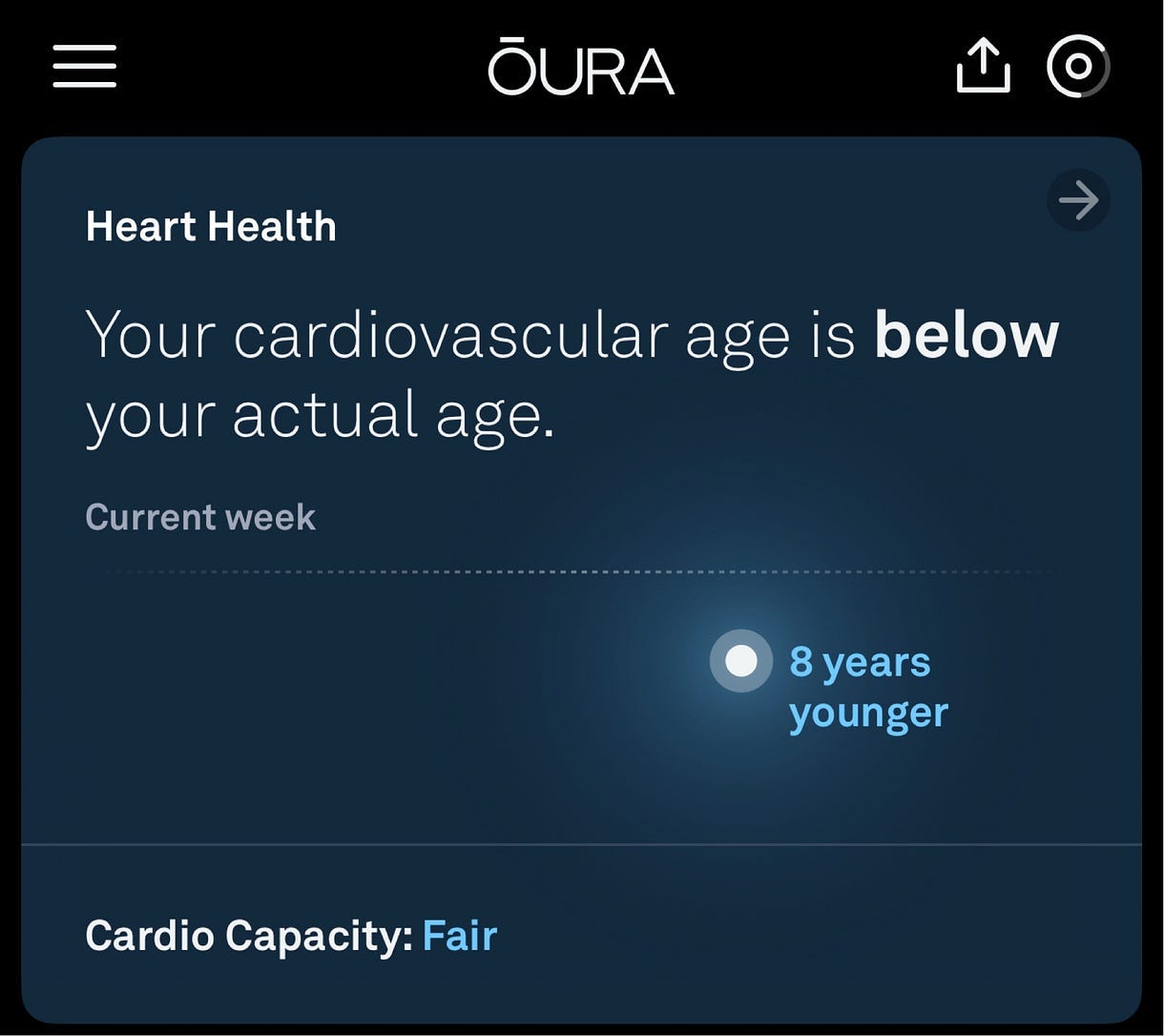 Screenshot
from my Oura Ring app. I track my cardiovascular age to ensure my
workouts improve my health and not just my appearance.
Longevity matters.
Unlike
the peak of his wrestling days, The Rock isn’t trying to push his body
to extremes anymore. He has a family, businesses, and a film career to
protect.
Slimming down now is a way of investing in his future, making sure he can stay active and productive for decades to come.
His career is evolving.
For
years, The Rock has been billed as the oversized action star. A
larger-than-life figure who commands the screen with sheer mass.
But at this stage, getting smaller actually opens new doors. With a closer to “normal” frame, he can play roles that he couldn’t at 260 pounds.
So
yes, the weight loss is tied to his next film. But in my view, it’s
also an intentional health decision that positions him for long-term
success both on screen and off.
We’ve Seen This Before
If The Rock’s weight loss looks familiar, that’s because we’ve seen a nearly identical story play out before.
Just
two years ago, another former wrestler turned gigantic Hollywood star,
Dave Bautista, dropped a reported 75 pounds. Publicly, he explained the
change as a combination of cleaner eating, more cardio, and a desire to
play more versatile roles.
The
media bought it because it was believable. But from a bodybuilder’s
perspective, Bautista’s transformation wasn’t a “weight loss journey”.
It was an obvious reduction in exogenous hormones.
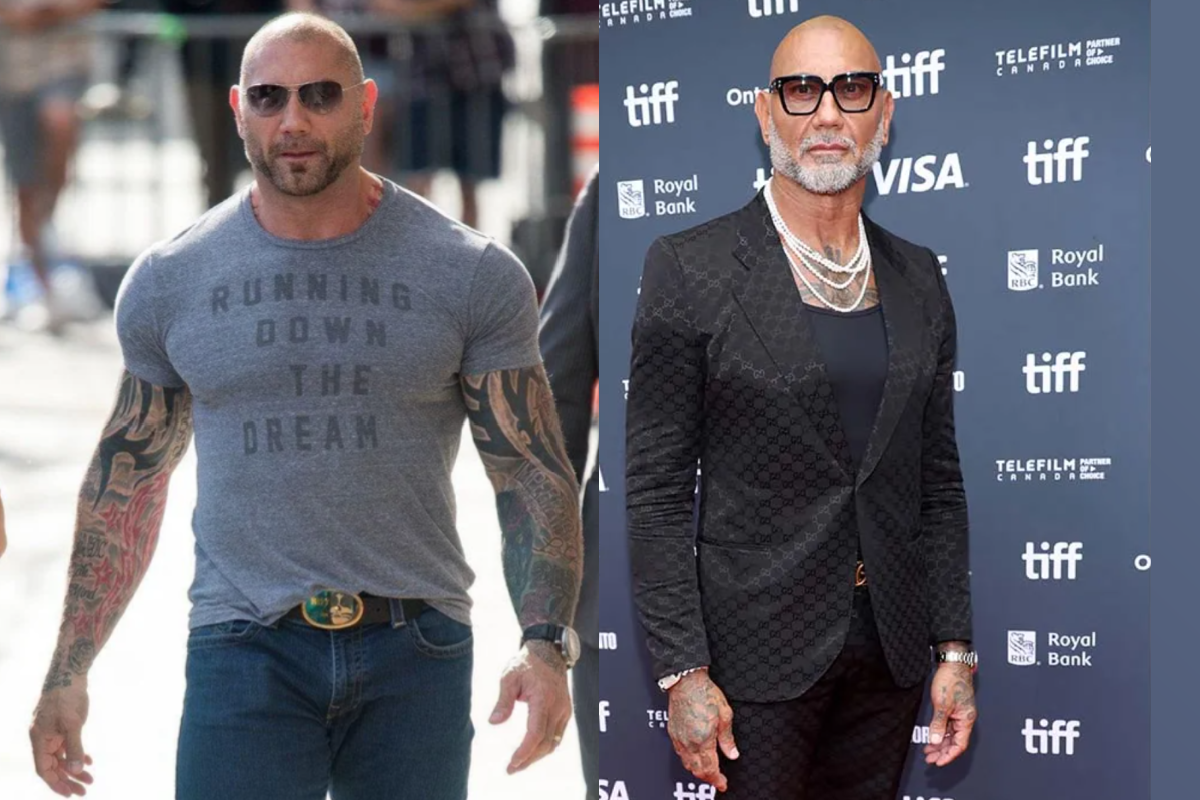 Image created by author showing Dave Bautista before and after his reported 75-pound weight loss.
At
the time, Bautista was also in his 50s. So the more likely explanation
was that he transitioned from full bodybuilding-style steroid cycles
down to TRT-level maintenance. The broader range of acting opportunities
was just an added benefit of slimming down.
Fast
forward two years, and Bautista has maintained his smaller stature. To
me, that reinforces the idea that the muscle loss wasn’t for a role. It
was a side effect of getting off the juice.
The
parallels to The Rock are uncanny. Two former wrestlers, both in their
50s, both slimming down dramatically, both citing film opportunities as
the public reason.
And
in both cases, the underlying driver appears to be the same — cycling
off steroids at an age where health risks outweigh the benefits of a
muscle-bound physique.
Debunking the Misguided Ozempic Myths
Whenever
a celebrity loses a significant amount of weight, the internet rushes
to fill in the blanks. In 2025, the default explanation seems to be
“Ozempic.”
Press enter or click to view image in full sizePhoto by David Trinks on Unsplash
That narrative quickly attached itself to The Rock’s rapid weight loss. Headlines speculated about him secretly using GLP-1 drugs like Ozempic or Mounjaro. These medications are a trending weight loss topic around the world, and several celebrities have admitted to using them. Plus, Ozempic is associated with muscle loss in addition to fat loss.
But let’s take a step back. Do
we really believe that The Rock— a lifelong athlete, with decades of
experience in nutrition and training, and access to the best coaches and
doctors — needs Ozempic to lose weight? Of course not. He already knows how to cut weight effectively through diet and exercise.
However,
this transformation isn’t just weight loss. The Rock already had
visible abs most of the time. This is a deliberate effort to shed muscle
mass.
Therefore,
the more likely explanation is that he hopped off the gear. When you
stop running supraphysiological doses of steroids and growth hormones,
your body sheds size and muscle mass dramatically. That’s what we’re
seeing here.
The
media latches onto Ozempic because it’s a hot-button drug right now.
But in reality, this isn’t about starting a new weight loss drug. It’s
about stopping an old muscle gain drug.
Why It Matters
For
some of you, this may seem like petty celebrity gossip. Does it really
matter that The Rock lost weight or how/why he did it?
Normally, it wouldn’t. But in this case, it matters because the truth about performance-enhancing drugs is hidden.
It’s false advertising.
The
“fake natty” influencers of the internet age deliberately deceive the
public by lying about their drug use and telling half-truths about how
they attained their physiques.
They use their bodies as a billboard that says:
- “Buy my workout program, and you can be as strong as I am.”
- “Buy my clothing line so people will know you work as hard as I do.”
- “Buy my supplements, and you can look jacked like me.”
It’s false advertising, and they know it.
The
Rock, in particular, boasts a vast portfolio of brands and
partnerships, including a clothing line, energy drinks, men’s grooming
products, and even a tequila.
Photo by Anastase Maragos on Unsplash. This gym-goer is sporting a hat and shirt from Under Armour’s Project Rock.
It sets unrealistic expectations.
Enhanced
actors, athletes, and fitness personalities intentionally lead fans to
believe their physique is attainable through hard work, chicken and
broccoli, and whey protein supplements.
When
those people fall short, they blame themselves for not having the
willpower or discipline, when in reality, they were chasing a lie.
Some give up on their fitness aspirations. Others come to realize that their idol must be taking steroids and covering it up.
It fuels dangerous shortcuts.
Many
young men, frustrated by their lack of progress, experiment with PEDs
themselves. They think, “I can be like him if I just take steroids.”
Usually,
it’s without proper knowledge, medical supervision, or awareness of the
long-term risks. In which case, they get the side effects and body
image issues without the desired results.
Because
the truth is, the top athletes and stars didn’t get where they are by
steroids alone. It takes a combination of great genetics, dialed-in diet
and training, and experts to help them navigate the complexities of
hormones and anabolics.
It ignores the bigger cultural problem.
Steroids
are ingrained in fitness, sports, and even the entertainment business.
But by sweeping them under the rug, these industries keep people
misinformed. It prevents a more constructive conversation about what’s
really going on behind the scenes.
For
me, this isn’t about exposing anyone. What someone chooses to do with,
or put in, their body is their choice. I don’t even blame The Rock for
not coming clean — it could be career suicide due to public perception
alone.
What I object to is the culture of dishonesty surrounding PED use.
If
we can’t be honest about what it really takes to create these
physiques, then the public never has a fair shot at understanding what’s
possible naturally, what isn’t, and what the risks really are.
Final Thoughts
To
be clear, what I’ve shared here is educated speculation. I haven’t seen
The Rock’s bloodwork, his prescriptions, or the inside of his medicine
cabinet.
What
I do have is decades of experience in weightlifting, bodybuilding, and
coaching. From that vantage point, the signs point to scaling back
steroids and intentional muscle loss, not purely weight loss due to
calorie restriction.
It
remains to be seen whether Johnson will keep this smaller body for the
long term or attempt to build back toward his former size. The latter
would be a steep hill to climb at his age, and the risks of chasing that
kind of mass only grow with time.
Photo by Erik Mclean on Unsplash
What
I hope you take away from this is that steroids and PEDs are not rare
outliers in bodybuilding, wrestling, or Hollywood. They’re common. And
when the truth is hidden, the public is left idolizing illusions,
falling for false advertising, or turning to shortcuts without
understanding the risks.
If
The Rock has indeed decided to move away from years of heavy PED use, I
applaud that. It’s a smart and healthy choice that could extend not
only his career but his life.And he will still be in better shape than 99% of people because he has the genetics, dedication, and know-how to do so.
What
I want to shed light on is the ongoing delusion—our society’s
willingness to ignore the 800-pound roided-out gorilla in the room.
Until
we’re honest about performance-enhancing drugs, people will continue to
struggle with diet, exercise, and body image issues. More importantly,
the real conversation about physical and mental health never gets
started.